
Stainless steel elbows are fittings used to connect pipes and change the direction of pipelines, typically made from stainless steel.
The primary function of stainless steel elbows is to connect two pipes with the same or different nominal diameters in a piping system, enabling the pipeline to turn at a specific angle. Based on the angle, the most commonly used types are 45°, 90°, and 180°. Additionally, depending on engineering requirements, other non-standard angles such as 60° are also available. Connection methods to pipes include direct welding, flange connections, threaded connections, and socket connections, among others.
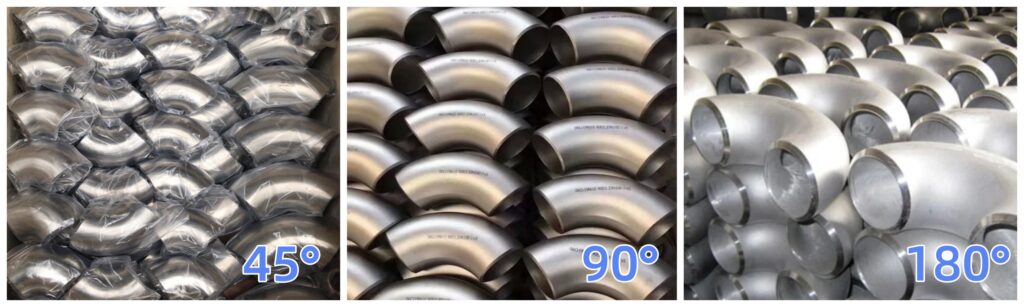
Classification by Angle
1. 45 Degree Elbow
Turn angle: Achieves a 45° directional deflection, suitable for long-distance pipelines requiring minor directional adjustments or when the angle between two pipeline sections is 45°. Primarily used for minor changes in pipeline direction or scenarios requiring mitigation of fluid impact force.
Bending angle: Achieves a 90° right-angle turn, the most commonly used type, suitable for “vertical/horizontal direction switching” scenarios (e.g., pipelines transitioning from the ground to walls, or right-angle connections between equipment inlets/outlets).
3. 180 Degree Elbow
Bending angle: Achieves a 180° U-turn (U-shaped bend), essentially a “reverse bend” where the fluid direction is completely reversed. Primarily used to change the fluid direction by 180 degrees, commonly found in U-shaped piping, heat exchangers, and other equipment to save space or achieve special process requirements.
Classification by Bending Radius
Long Radius Elbow (LR Elbow): The bending radius is 1.5 times the pipe diameter (R=1.5D). It has low fluid resistance and a smooth change in flow direction, making it suitable for applications requiring low fluid resistance, where the conveyed medium has low viscosity, or contains solid particles.
Short-radius elbows (SR Elbow): The bending radius is equal to the pipe diameter (R=1D). They have relatively higher fluid resistance but are structurally compact and space-saving, making them suitable for applications with limited space or where fluid resistance requirements are not stringent.
2D indicates that the bending radius is twice the nominal diameter of the pipe, and similarly, 3D indicates twice the nominal diameter of the pipe. These also belong to the category of long-radius elbows, but they differ from the commonly used 1.5D elbows in that they are smoother and are suitable for specific applications.
Classification by Connection Types
Butt weld Elbows: These are connected to pipes using welding, with flat ends designed to be directly welded to the pipe ends to form an integrated sealed structure. This connection method is suitable for medium- and high-pressure pipeline systems, particularly in large-diameter (DN50 and above) applications, where it offers significant advantages. It can withstand high pressures and temperatures, and the welded joints have high strength and excellent sealing properties, effectively preventing medium leakage.
Socket Weld Elbows: Features a socket with a groove-shaped opening, allowing the pipe end to be directly inserted into the socket. Sealing is achieved through a seal ring or welding (socket-weld). Socket-weld connections offer reliable sealing performance, suitable for applications requiring high sealing integrity but operating within the medium-pressure range. This method also reduces issues caused by improper welding and allows for relatively easy disassembly during maintenance.
Threaded Elbows: These have threads on the inner or outer walls and can be connected to pipes with corresponding threads via a screw-tightening method, without welding, forming a removable connection. This method is suitable for low-pressure, small-diameter pipes, offering fast installation and ease of maintenance and replacement. However, the sealing performance of threaded joints is significantly influenced by thread precision and sealing materials, making them unsuitable for high-pressure, high-temperature, or highly corrosive medium transportation systems.
Stainless Steel Elbow 45, 90, 180 Degree Material
The material of stainless steel elbows is usually selected according to the use environment and medium. Common ones are:
304 stainless steel: The most commonly used stainless steel material, with good corrosion resistance and processing performance, suitable for general corrosive environments.
316/316L stainless steel: Molybdenum is added, which has better resistance to chloride ion corrosion and is suitable for marine environments, chemicals, medicines and other occasions with higher requirements for corrosion resistance. 316L is a low-carbon version of 316 with better welding performance.
Other stainless steel grades: According to special needs, 201, 202, 321, 904L, duplex stainless steel (such as 2205, 2507), etc. can also be selected to meet different requirements for temperature resistance, pressure resistance, corrosion resistance, etc.
| CHEMICAL | LIMITS | C | Mn | P | S | Si | Ni | Cr | Mo |
| 304 | MIN | 8.0 | 18.0 | ||||||
| MAX | 0.08 | 2.00 | 0.045 | 0.030 | 1.00 | 11.0 | 20.0 | ||
| 304L | MIN | 8.00 | 18.00 | ||||||
| MAX | 0.03 | 2.00 | 0.05 | 0.03 | 1.00 | 12.00 | 20.00 | ||
| 316 | MIN | 10.0 | 16.0 | 2.00 | |||||
| MAX | 0.08 | 2.00 | 0.045 | 0.030 | 1.00 | 14.0 | 18.0 | 3.00 | |
| 316L | MIN | 10.00 | 16.00 | ||||||
| MAX | 0.03 | 2.00 | 0.05 | 0.03 | 1.00 | 14.00 | 18.00 | ||
| 904L | MIN | 23.00 | 19.00 | 4.000 | |||||
| MAX | 0.02 | 2.00 | 0.045 | 0.035 | 1.00 | 28.00 | 23.00 | 5.000 |
Stainless steel elbow dimensions – 45°,90°,180°
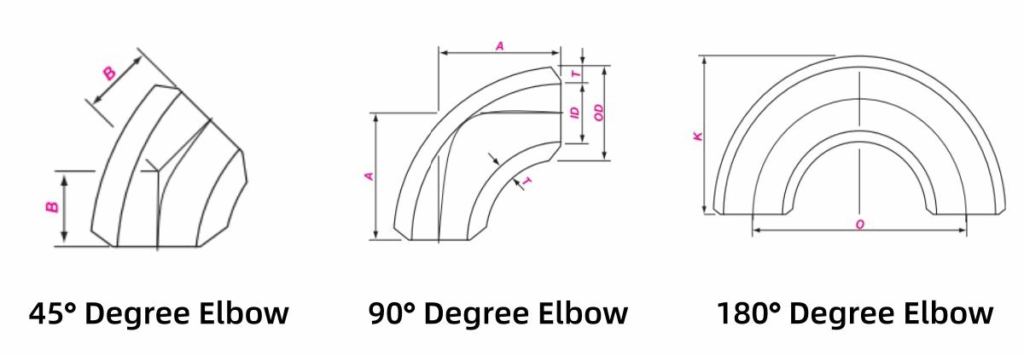
| Nominal Size | Outside Diameter at Bevel | Center to End | Center to Center | Back to Face | |||||
| 90° Elbows | 45° Elbows | ||||||||
| DN | NPS | OD | A | B | O | K | |||
| LR | SR | LR | LR | SR | LR | SR | |||
| 15 | 1/2 | 21.3 | 38 | 16 | 76 | 48 | |||
| 20 | 3/4 | 26.7 | 38 | 19 | 76 | 51 | |||
| 25 | 1 | 33.4 | 38 | 25 | 22 | 76 | 51 | 56 | 41 |
| 32 | 1 1/4 | 42.2 | 48 | 32 | 25 | 95 | 64 | 70 | 52 |
| 40 | 1 1/2 | 48.3 | 57 | 38 | 29 | 114 | 76 | 83 | 62 |
| 50 | 2 | 60.3 | 76 | 51 | 35 | 152 | 102 | 106 | 81 |
| 65 | 2 1/2 | 73.0 | 95 | 64 | 44 | 190 | 127 | 132 | 100 |
| 80 | 3 | 88.9 | 114 | 76 | 51 | 229 | 152 | 159 | 121 |
| 90 | 3 1/2 | 101.6 | 133 | 4、89 | 57 | 267 | 178 | 184 | 140 |
| 100 | 4 | 114.3 | 152 | 102 | 64 | 305 | 203 | 210 | 159 |
| 125 | 5 | 141.3 | 190 | 127 | 79 | 381 | 254 | 262 | 197 |
| 150 | 6 | 168.3 | 229 | 152 | 95 | 457 | 305 | 313 | 237 |
| 200 | 8 | 219.1 | 305 | 203 | 127 | 610 | 406 | 414 | 313 |
| 250 | 10 | 273.0 | 381 | 254 | 159 | 508 | 518 | 391 | |
| 300 | 12 | 323.8 | 457 | 305 | 190 | 914 | 609 | 619 | 467 |
| 350 | 14 | 355.6 | 533 | 356 | 222 | 1067 | 711 | 711 | 533 |
| 400 | 16 | 406.4 | 610 | 406 | 254 | 1219 | 813 | 813 | 610 |
| 450 | 18 | 457.0 | 686 | 457 | 286 | 1372 | 914 | 914 | 686 |
| 500 | 20 | 508.0 | 762 | 508 | 318 | 1524 | 1016 | 1016 | 762 |
| 550 | 22 | 559.0 | 838 | 559 | 343 | 1676 | 1118 | 1118 | 838 |
| 600 | 24 | 610.0 | 914 | 610 | 381 | 1829 | 1219 | 1219 | 914 |
| 650 | 26 | 660.0 | 991 | 660 | 406 | ||||
| 700 | 28 | 711.0 | 1067 | 711 | 438 | ||||
| 750 | 30 | 762.0 | 1143 | 762 | 470 | ||||
| 800 | 32 | 813.0 | 1219 | 813 | 502 | ||||
| 850 | 34 | 864.0 | 1295 | 864 | 533 | ||||
| 900 | 36 | 914.0 | 1372 | 914 | 565 | ||||
| 950 | 38 | 965.0 | 1448 | 965 | 600 | ||||
| 1000 | 40 | 1016.0 | 1524 | 1016 | 632 | ||||
| 1050 | 42 | 1067.0 | 1600 | 1067 | 660 | ||||
| 1100 | 44 | 1118.0 | 1676 | 1118 | 695 | ||||
| 1150 | 46 | 1168.0 | 1753 | 1168 | 727 | ||||
| 1200 | 48 | 1219.0 | 1829 | 1219 | 759 | ||||
Applications of Stainless Steel Elbows
Petroleum and Natural Gas: Transportation of crude oil, natural gas, refined oil, etc.
Chemical Industry: Transportation of various acidic and alkaline corrosive media.
Power: Cooling water systems in power plants, steam pipelines, etc.
Construction: Water supply and drainage systems, fire protection pipelines, etc.
Food and Pharmaceuticals: Conveying fluids with high hygiene requirements.
Water Treatment: Wastewater treatment, desalination, etc.
Shipbuilding: Shipboard pipeline systems.
You can get an offer for products in below material forms:
-Pipe and Tube (EN 10216-5, ASTM A213, ASTM A249, A312, A790,)
-Forged Fitting and Flange (ASTM A182 , ASTM A105,ASTM B564 )
-Butt Weld Fittings (ASTM A234, ASTM A403,ASTM A815)
-Round bar , Billet (ASTM A276, ASTM A479)
– Plate, Sheet, Strip(ASTM A240, EN 10028-7, A480)
-Bolting, Nuts(ASTM A193, A194, A320)
Stainless Steel Elbow 45, 90, 180 Degree Exported Countries
We Export Stainless Steel Elbow 45, 90, 180 Degree to Saudi Arabia, United Arab Emirates, Qatar, Bahrain, Oman, Kuwait, Turkey, Egypt, Yemen , Syria, Jordan, Cyprus, Singapore, Malaysia, Indonesia, Thailand, Vietnam, South Korea, Japan, Sri Lanka, Maldives, Bangladesh, Cambodia, Argentina, Bolivia, Brazil, Venezuela, Colombia, Ecuador, Guyana, Paraguay, Uruguay, United States Of America, Canada, Mexico, Panama, Jamaica, Bahamas, Denmark, Norway, Germany, France,Italy, United Kingdom, Spain, Belgium, Greece, Czech Republic, Portugal, Hungary, Albania, Austria, Finland, Ireland, Croatia, Malta, Nigeria, Algeria, Angola, South Africa, Libya, Egypt, Sudan, Europe, Africa, Asia, North America, South America, Middle East.etc